Wednesday, 30 December 2015

TRANSATLANTIC CROSSING 8 to 22 December 2015

We made it.! Anchored in St Anne's bay on Martinique midnight local time on the 22nd December, then moved to the 'Le Marin' marina on the 23rd of December and were greeted enthuisiastically by the other Island Odyssey participants who were already there. Just in time for Christmas.!

To summarise the journey's main points:
OBSERVATIONS
1/ WIND AND SAILS
Most of the time the trade winds are constant 15 to 20 knots, however we experienced three different situations. The first third of the trip the winds were light at 5 to 10 knots so we used the spinnaker. The second third of the trip there was less than 5 knots so we motored for four days, then the final five days were hectic with 15 to 20 and occasionally up to 25 knots of wind, however the worst part was the swell that came from three directions. From the North due to a storm in the area, from the North-East and from the East from where the wind blew. The various swells made it difficult to steer and very uncomfortable.
The fluky wind direction caused us to lose our A sail when the sheet became un-clipped on one of the mast stays. We had to dump the sail in the sea and recover it from there. Unfortunately due to its light weight material it ripped to pieces during recovery.
We used poled out Genoa during most of the trip, and because of the balanced setup there was no chaffing at all. We used the main sail during lighter winds but due to 'banging' we limited its use. Later we noted a pulled rivet on one of the main sheet attachments caused by the severe tension fluctuations. The spinnaker was used in 5 to 10 knots of wind.
2/ BIRDS AND WEED
In mid Atlantic we came across large areas of floating weed. This tended to accumulate on the rudder and propeller, causing engine vibration. When the winds were higher and seas rougher the weed dispersed.
We did not see any Dolphin or Whales, and very few birds (about five or ten during the whole trip).
However we did have two egret birds on board for a couple of hours. They needed a rest on their transatlantic journey.
Desert sand was a nuisance for the first two thirds of the way, cockpit and cabin became grimy. The Cape Verde islands lives under a smog of desert sand.
3/ SQUALLS 
These were very frequent during our last four days. They brought very strong winds. You could see them approaching during the day but not at night so we reefed for winds of 25 knots.
When rounding the Southern tip of Martinique (at night) we noted that this was a wind and wave "funnel" or acceleration area. Best to keep heading West after the cape until the wind and waves normalise before heading North to FdF.
4/ FOOD
Food organisation was good. We had pre-cooked about twenty meals consisting of stewed meat, bolognese sauces, vegetable stews. This saved a lot of hassle since we were just two on board. We also stewed apples and pears. Breakfast was usually cereals with milk, plenty of tea. Then biscuits and nuts for casual eating during the day. Evening meal was mostly a hot meal except when conditions were rough.
5/ WATER
Drinking water was filtered tank water. After the finish we still had a full tank indication (350litres), although we did top up once using our water maker. We showered every day to basically survive the boredom and discomfort of constant swell and dusty / salty air.
6/ POWER
We ran our generator three times during the rough approach to Martinique because the autopilot was so busy and there was no sun to make use of the solar panels. The wind generator was quite useful when it had about 15 knots of wind. It could just about keep up with the autopilot demand.


Monday, 28 December 2015

WE DEPART FOR THE SECOND TIME FROM MINDELO, 8 Dec

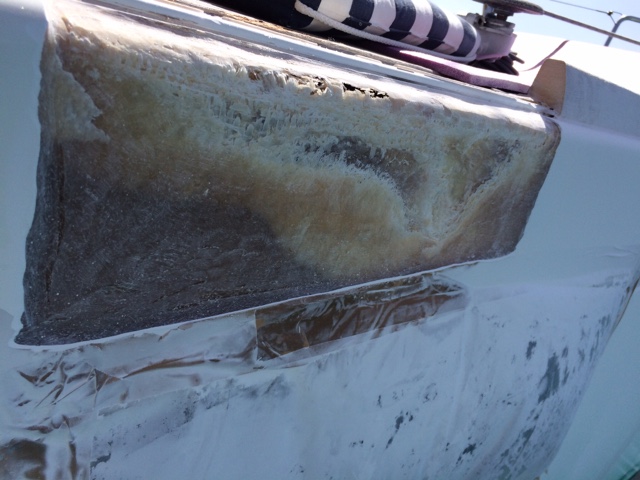
The temporary repair was done according to our own design, signed off by the surveyor from Lisbon. It took about ten hours of hard work by some brave Cape Verde mechanics, hanging on the side of the boat in howling winds and a significant marina swell. It was done in two stages. First the grind-out and filling with new GRP inside and outside, then the installation of the window plug.
The next hurdle was the weather forecast. All of a sudden there was no wind out in the Atlantic because the 'horse latitudes' had moved South into the path of the usual trade winds. We therefore had to wait at anchor with some other folk that we had met who owned a HR49. They had even changed their destination to Surinam in order to cruise south of the zero wind zone.
Anyway on the 8th December we thought it was about time and we left the anchorage and headed West. We were on out way at last.!


Saturday, 5 December 2015

WAITING IN MINDELO, 4th DEC

The temporary repair was eventually completed on the Wednesday 2nd December in the evening at about 20.30. Our trick to get it completed was to demand that the insurance surveyor stayed until the job was done so that he could approve it and thereby allow us full continuation of our insurance. He had planned to just come and make his demands then dissappear and leave us with further headaches....
This surveyor (from Lisbon) was a nice enough fellow but pretty incapable, and loved telling us stories. He didn't even manage to perform a summary of the damage for the final repair.
Now we have to liaise with 'Netmarin' in Martinique to get a 'slot' for the final repair, and some kind of estimate on down-time.
So the saga is to continue.


Saturday, 28 November 2015

WE DEPARTED ON SCHEDULE 24th NOV, BUT HAD TO RETURN TO MINDELO

Beautiful departure at about 10.00 local time here in Mindelo on the 24th November turned into our worst experience so far. A British registered boat called Lionheart of Clyde rammed us at 6 knots while we were raising our mainsail before heading out across the Atlantic.
The captain of this yacht was running on autopilot within the harbour and was not even at his helm, so he had very little chance to avoid us. We were sailing at the time so although we saw him coming we couldn't take avoiding action. We just shouted and then suffered to worst impact you can imagine. The culprit was as shocked as we, and tried to leave the scene. Luckily we got help from the marina manager and he called the port police. So the culprit returned reluctantly. He was very contrary in all respects and refused to fill out an insurance claims form. I had contacted both party insurances within an hour.
End result... We are now stuck in Mindelo with smashed window and structure damage where there is little chance of any repair.! Desperate! Our dreams of the Caribbean fading fast.


Sunday, 22 November 2015

WAITING IN MINDELO

Nerves are on edge as we do final preparation ( our mental prep and the yacht prep). Last bit of veg shopping, some social events and route planning. We have checked the time zone and exchanged rates for Bridgetown Barbados which is our next destination after leaving MINDELO.


Saturday, 21 November 2015

EL HIERO TO THE CAPE VERDE ISLANDS. 780 NM SOUTH EAST. 14 NOV

The beginning of the long traverse.! To follow the trade winds most yachts crossing the Atlantic head south (until the butter melts) then catch the trades across to the Caribbean.
Our Islands Odyssey was from the Canary island of El Hiero, which is the most Westerly point of the Canaries, with a scheduled stop-over in the Cape Verdes.
Many other transatlantic sailors just take the direct route from Canaries to Saint Lucia, without a stop. This takes about 20 days.
Our trip here (to Mindelo) would take volumes to describe, so to keep it short we can say that it was rough and persistent.! However we arrived in the amazing island of Sao Vicente on a sunny afternoon with azure sea and epic landscapes.
780 nautical miles in 5 days and seven hours.


Saturday, 14 November 2015

LA PALMA TO EL HIERO, 12 Nov

This was the first leg of our transatlantic "Islands Odyssey". A relatively short sail of 55 Nautical miles from La Palma to the furthest South West island in the Canaries group. Weather was calm at first and then became more ragged with high swell and 23knot winds from the North. It was a downwind sail so we used our polled-out genoa sail and main. We started very sedately in the group of yachts that made up the "rally" then gradually overtook everyone to arrive at El Hiero in the lead. Our Kwanza certainly showed her sailing speed.